I was asked to share my thoughts today in church during an
Elder’s Quorum lesson about “where our choices lead.” At first, I didn’t know
what to say. This is actually a very difficult question to answer for someone
like me. As a gay and active member of the Church, I am constantly considering
this question because I am straddling two paths – both of which would lead me
to very different destinations. If I were to embrace a completely homosexual
lifestyle, I would give up many of the blessings I enjoy by being an active
member of the church. On the other hand, by embracing the standards of the
Gospel of Jesus Christ, I miss out on the possibility of a romantic/intimate
companionship that all human beings need. I can’t have both.
But this post isn’t about the conflict I feel, living
between two worlds. This post is not about justice, equality, or fairness –
religious or otherwise. This post isn’t even about me asking “why.” I could
delve into a myriad of questions I’ve had over the course of my life, not the
least of which is, why have I been burdened with being gay in a
hetero-family-oriented church? No, this post isn’t about all of that. This post
is about living with unanswered questions.
I won’t go into detail about what I shared with the brothers
in the Elders’ Quorum lesson today, mostly because I’m pretty sure I was
bawling like a baby through all of it, even though it only lasted about 5
minutes. But, I do want to share one thing I said, which is the foundation of
what I want to share in this post. Regarding my circumstances, as stated above,
I shared this, “The Lord knows me. He knows this is hard for me. But I know
there is a reason to have faith; even if I don’t know the reason yet – I know
there is one.”
Essentially, I am choosing to live a faith-centered, abstinent
lifestyle, without really knowing why. I have no proof that my faith will be rewarded.
I have no proof that I’m making the right choice. But I am making that choice.
I am choosing to abstain from a fully gay lifestyle, in order to remain a
member of the Church of Jesus Christ of Latter-Day Saints in good standing. (I
know many people in my situation have opted to leave the church and I fully
support them in their decision – we all have a different path and we all
deserve to be loved and accepted for who we are regardless of the path we
choose.)
I guess that’s what I think faith is – moving forward when
we don’t yet have all the answers. Which is, as I’ve come to realize, unbelievably
ironic for me. You see, I seem to have a great deal of faith when it comes to
religious/spiritual matters. But I have recently come to know that I don’t seem
to have much faith anywhere else in my life.
When I look in the mirror, I hate what I see. When I look in
the mirror, I see how fat I am and I hate it. I hate how it looks, I hate how
it feels and I hate the burden that it creates in my life on every level –
physical, mental, emotional, and spiritual. I hate that I can’t physically do
things I want to do; I hate that I can’t wear clothes I want to wear; I hate
how self-conscious I am and every time I go out in public, I worry that people
are going to laugh at me, make fun of me, or look down on me. I worry that they
will think about me the way I think about myself – weak, lazy, ugly, and
stupid.
I have been on a multi-year journey to fix this – to lose
weight, to feel better about myself and my life. I’ve had some successes, but
many, many failures and every failure gets harder and harder to get back up
from. The problem, if I can oversimplify, isn’t about knowledge or opportunity –
I’ve had an abundance of both. The problem is that I tried to move forward
without faith. Maybe it seems ridiculous to you, but I think it takes faith to
change nutrition and exercise habits. Every time I started a new diet, or a new
exercise program, or hired a new trainer, I struggled to put faith into the
process or the person who was coaching me. I struggled with cutting things out
of my diet, restricting calories, trying new exercises, needing to modify exercises
to my ability level and so on, because I didn’t really know if it was going to
work or not. The outcome of changing lifestyle habits was my unanswered
question – was this really going to work for me this time?
Paradoxically, there were times when I did put my faith in
the process and several times it did pay off – it paid off in increased
strength, flexibility, weightloss, increased energy, and so on. But then I had
a set-back. Several circumstances made me question my faith in the process, so
much so, that I gave up on it. I gave up on eating right; I gave up on
exercise. And it took its toll. I lost the energy I had gained. I gained back
the weight I had lost. I lost strength, flexibility; and probably the worst
part – I lost believing in myself.
As I’ve contemplated the things I’ve lost and as I’ve
pondered on the seemingly inexhaustible supply of self-loathing I experience on
a daily basis, and especially in light of what I was reminded of in church
today – I realize that the one thing I’ve
never had any faith in – is me. When I had faith in the process of weightloss,
it worked, I did lose weight, and it felt great. But I didn’t believe that I
was worth it. I didn’t have faith that I could sustain the progress I had made
because I didn’t have faith in myself. And I inevitably gave up on the process
of weightloss.
I have spent thousands of hours, years even, money, tears,
and whatever energy I could muster to try to understand why I am the way I am.
Don’t get me wrong, I’m not bagging on therapy – I love therapy and I’m a huge
advocate for it. But after so much time and energy trying to understand why, I
think I’m at a place where I realize that some questions just aren’t going to
be answered. I don’t know why my first, visceral reaction is to hate myself; I
don’t know why I have an aversion to doing anything “hard,” or that will make
me look stupid; I don’t know why a good body and self-confidence come so easily
to others and not to me. I don’t know why I have to fight my own brain every
single day just to function in this world, let alone improve myself. And maybe
I won’t ever know. Maybe that’s what faith is – to not know, but to move
forward anyway. Maybe what I have needed, more than “answers” is just to have
faith that I am worth it; that I can do it; that regardless of how successful I
am (I really want to lose that “last” 100 pounds!!), that I’ll be better off
for even trying.
Going back to a point I wanted to make – it seems strange
that I have no problem having faith in an omniscient/omnipotent being that I
can’t see, hear, smell, or touch and yet I can’t have faith in the very
physical, tangible experience of being me. I can’t help but ask myself, “what
would having faith in myself look like?”
I literally just spent the last 10 minutes looking off into
space because I don’t know how to answer that question…
I guess it would mean pursuing health and fitness without
having to defend or justify myself. I would do it because it would make me
happy. I think it would mean being willing to make sacrifices of junk
food/binge eating because I know those things don’t really make me happy
long-term. I think it would mean being willing to accept all the bad things
that come with life – being willing to be in pain, to be uncomfortable, to
sacrifice or go without something I may want in the moment; and knowing that
life doesn’t present hardships as a punishment – it’s just a part of life and
it’s okay. I think it would mean accepting that some things are just hard, and
that it doesn’t mean it’s wrong, or that I’ve done something wrong.
It has been difficult to face hard things because I haven’t
felt that I was worth it. I also just realized that when something gets hard, I
immediately react with feelings of indignation. When I face something hard, I
hear my inner voice saying, “this isn’t fair…” And you know what? It isn’t. It
isn’t fair that I have to work so hard to lose weight when it comes so easily
to other men. It isn’t fair that I have to sacrifice enjoyable food when other
men can eat whatever they want and not gain weight. It isn’t fair that I’ve
been through so much trauma, only to have to work even harder at changing my
thoughts/beliefs as a result. It isn’t fair that I have to deal with the
fallout of things that happened to me, that I didn’t cause, that I didn’t want
and that I never would have chosen. It isn’t fair that I have to suffer the
consequences of other people’s bad choices/behavior. Yes, I know that makes me
sound like a brat – and maybe that’s all I’ve ever been. But I’ve avoided and I’ve
retreated and I’ve hid myself away because I just can’t face dealing with hard
things when it wasn’t my fault to begin with. Well that also sounds like a
victim talking…
Okay, so it isn’t fair. I am absolutely, 100% right – it’s
not fair.
Now what?
Where does “it’s not fair” actually get me? Nowhere!!
Focusing on “it’s not fair” just leaves me stuck. I don’t have the answer, but
maybe, just maybe, one way to get past “it’s not fair” is to realize that what
it is, is an opportunity.
No, I didn’t want to be molested. And it isn’t fair. But it
is an opportunity to forgive. No, I didn’t want to be morbidly obese. And it
isn’t fair. But it is an opportunity to learn to appreciate the body God has
given me. No, I didn’t want to live my life hating myself because other people
hurt me. And it isn’t fair. But it is an opportunity to triumph in the face of
adversity.
Maybe what “isn’t fair” is also an opportunity for faith. I
think having faith in myself is trusting that what I want is okay to want; that
I am worth achieving and maintaining improved health and fitness; that it’s
okay that the process will be hard at times, but that the outcome will be worth
it.
I think having faith in myself will mean doing the hardest thing
possible: accept myself for who I am, the way I am, fat and all.
I have gotten used to beating myself up and I have gotten
used to misery. I think it will be just as hard to admit that I’m okay, as it will be to accept that I’m okay. I have never allowed myself to be truly
happy. I thought I needed to change, to achieve an ideal body/success, in order
to matter, in order to be happy. So I’ve never allowed myself to really be
happy. I was afraid that if I was happy then something bad would happen to “balance
it out.” I was afraid that being happy meant I was being selfish. I was afraid
that being happy meant taking happiness away from others, because there’s only
so much to go around. I was afraid that being happy meant that I couldn’t
change my circumstances, that I had to give up my dreams of improving myself
physically or otherwise, because if I’m happy, then what else do I need?
It’s just occurred to me that I don’t think of happiness as
an outcome of choices I make (i.e., a side effect); I think of happiness as THE
destination – the whole end goal. Once you’re happy, that’s it – you’ve made
it. You’re happy and there’s nothing else to want or do because you don’t need
anything because you’re happy.
But what if happiness is NOT a final destination? What if
happiness is NOT an end, in and of itself?
What if happiness is like a jacket. You aren’t meant to wear
jackets all the time, but for some kinds of weather it’s the perfect comfort.
In that way, maybe fulfillment doesn’t come FROM simply “being happy,” but
maybe fulfillment comes from growth and achievement, and happiness just
sometimes comes along for the ride…?
Well this post just kind of went everywhere, didn’t it?
Sorry if it’s been all over the place. I didn’t realize until I started typing
this that the concept of happiness was such a contributing factor to my lack of
self-worth.
Ultimately, I don’t know what will come from all of the
realizations I’ve had today. I still have so many unanswered questions. But I
suppose that was really the whole point of this post in the first place: Faith
is just living life with unanswered questions – and unanswered questions are no
reason to stop living.
Sunday, July 28, 2019


Wednesday, May 1, 2019
What Do You Deserve?
I have recently experienced a huge set-back. I say recently, but in reality it’s been happening for over six months. In September of 2018 I hit a milestone – I lost 80 pounds! I’ve never lost that much weight before!
I looked at the number on the scale, hardly able to believe what it meant. Losing 80 pounds was more than halfway to my goal. My clothes were much looser and I was in need of buying smaller clothes, so it really shouldn’t have surprised me to see the number going down.
And in reality, I don’t know that it was the number itself that surprised me – it was my reaction to that number that surprised me. I remember feeling disbelief, then fear, then disappointment. It struck me that I should be over-the-moon happy with my weight being down, but I wasn’t. I got a little angry at myself, “Micah! Look at what you’ve accomplished! Why aren’t you happy about this?! Isn’t this what you’ve wanted your whole life? Well, it’s finally happening!! Why aren’t you happy or excited?”
First, my disbelief. The fact that I “couldn’t believe” I had lost 80 pounds means that I didn’t really believe that I would. How else do you explain being “surprised” by weightloss when weightloss IS THE GOAL?! Deep down, I never really believed that I could be successful at losing weight because I had tried SO MANY times before. Suddenly, this time was different. Something about this process had worked and I wasn’t ready for it. I was seeing it, but I wasn’t believing it. In that moment, I realized that something within me was out of alignment with my goals and how I saw myself (more on this below).
Second, my fear. This is convoluted, even to me. I was afraid of so many things. I was afraid that I wouldn’t be able to maintain that weightloss. I was afraid that if I didn’t maintain that level of weightloss that people would make fun of me or worse, look at me with that crushing pity or disappointment in their eyes. Suddenly I felt “pressure” to HAVE to keep the weight off and I was afraid that I couldn’t do it – I mean, I wasn’t even able to believe I had done it in the first place, so how could I maintain it? I was afraid that it would make some people feel bad about themselves. (I know, I said this was convoluted… which is just a fancy way of saying my thought process is SO F’d up!!) I was afraid that, rather than be happy for me, it might make others who are also trying to lose weight, feel bad that they haven’t lost weight or haven’t lost as much weight. I was afraid that if I shared my progress, people would think I was showing off or trying to be something I’m not (what does that even mean?! I have no idea!!).
Part of the fear was not purely my own though. I recall telling someone that I had lost 80 pounds, but still have “more to go” and their response was, “but is that realistic?” The moment they said it, my soul was crushed. Basically they were saying, “hey, you’ve lost this weight, maybe you should just be happy with that and stop trying to lose more. That way you won’t set yourself up for disappointment when you don’t lose any more weight.” I know the comment was well-meaning – they just wanted me to be happy, but it confirmed to me that other people don’t believe in me; don’t believe that I could lose any more weight and that I ought to just be happy with what I had achieved, or be happy at being slightly less fat than when I started, or just “accept” myself the way I am and stop trying to improve myself. Suddenly, I had confirmation that I should be afraid of not being able to lose more weight, because others didn’t believe I could either. Which is probably what contributed to…
Third, my disappointment. My original goal was to lose 140 pounds. Losing 80 pounds, as I said, is over halfway, but because it wasn’t 140 pounds, I hadn’t “met my goal.” Why be happy about losing 80 pounds, when I still have 60 more pounds to go? Losing 80 pounds was great, but it wasn’t enough. I couldn’t be happy about losing 80 pounds because I told myself (unknowingly), that I wouldn’t be happy until I reached 140 pounds lost. It’s all or nothing and I won’t be happy until ALL the weight is gone. The problem with saying, “I’ll be happy when…” is that you’re also saying, “I CAN’T be happy until…” Here I was, 80 pounds lost, AND I STILL WASN’T HAPPY. I was disappointed that I had ONLY lost 80 pounds and not 140.
Somehow, of all of the three feelings mentioned above, it was feeling disappointment that was most eye opening. The fact that I had achieved something I had never before achieved – and still wasn’t happy about it, made me realize just how bad my mindset has been. Even as I have gone through the grueling process of trying to change my outlook on life, I still had this deep, deep belief that I could only be happy in one way – at my ideal weight.
But since I had “failed” to reach that weight, I gave in to my disbelief, my fear, and my disappointment. It’s interesting – I didn’t stop going to the gym and I didn’t stop trying to eat clean, in fact, I went through a nutrition certification course so that I could coach others on optimal eating habits. But what did change, was that I stopped really believing that I could do this – that I could maintain 80 pounds lost, that I could lose an additional 60 pounds, that I could actually achieve my goal weight. What has been the result? Well, here I am 6-7 months later and I’ve regained 40 of the 80 pounds lost!!
This is devastating to me.
I feel so disappointed in myself. I feel like a fraud for wanting to help other people eat well and lose weight, when I can’t even seem to do that for myself!
I’ve been asking myself for weeks/months, “what’s wrong with me? Why can’t I get my act together? Why do I keep messing up, failing, and hurting myself – mentally and nutritionally?”
It finally dawned on me one day with alarming clarity: I just don’t deserve it.
When this thought came to the surface, I realized how much it felt like “me.” This is my identity; this is who I am – a man who is undeserving of anything good in his life. I don’t know why I haven’t realized it until now. How could I not have seen it until now? But now that I do, I look back over my life and I realize that it has been there the whole time. This belief has been with me for as long as I can remember, influencing every moment of my life, every choice I’ve made, every circumstance I have found myself in. Maybe I couldn’t see it because it was so good a hiding or masquerading as something else – such as being a victim, not measuring up, being afraid, etc. Being undeserving has been a part of all of those things, like an undercurrent that can’t be seen, but influences everything above it.

I have ruined diets, binged, and given up on myself over and over again, because I didn’t believe that I deserved anything better. If I did feel like I deserved something, it was that I deserved punishment, pain, and suffering. No wonder being miserable “feels right,” it’s all I’ve felt I’ve deserved. I deserve to be fat, ugly and lonely because I don’t deserve to be healthy, attractive or in a relationship. I don’t deserve to lose more weight, because that would make me happy and I don’t deserve to be happy!
Being undeserving can – and has – cut through every facet of my life. I think this is why I felt “disbelief” at having lost 80 pounds, as I mentioned above; as well as why I felt fear about losing weight – because I had achieved something I didn’t “deserve.”
For as long as I can remember I’ve had this really weird belief system that goes something like this: If I deserved to have something in my life, then I would have it; if I don’t have something in my life, it’s because I don’t deserve it. A couple of examples of this are: If I was deserving of having a good body, then I would have one (and not have to work for it?); but since I don’t have a good body, I don’t deserve it. Or, on the negative side: Since I was molested as a child, I must have deserved it, because if I didn’t deserve it, it wouldn’t have happened…
It’s as if the condition of having or not having something in my life is somehow “irrefutable proof” of this Deserving rule. Honestly, I have no idea where, when or how this rule developed, but I obviously felt it was so reliable that it just became a part of me.
Which leads me to my next question: now what?
Now that I see what I’ve been doing consciously or unconsciously my whole life, what do I do about it now? How do I just flip the switch and say, “ohp, gosh, you know what? wait…, wait, wait… I guess I was wrong this whole time; I really am deserving of having good things and being successful…!”
Like, I can’t do this. I can’t just wake up tomorrow and suddenly believe that I’m deserving of all good things – it’s far too incongruous with my experience. How do I lie to myself and tell myself that I suddenly deserve all the things I’ve told myself my whole life I DON’T deserve?
On the other hand I have this little “mindset coach” in the back of my head asking, “why does being deserving even have to factor into the equation? Why does everything have to be related to whether or not you deserve it? What if you took ‘being deserving’ out of the equation, period?”
Those are good questions, but I don’t know what that would look like. I don’t know how to answer those questions. Perhaps, instead of looking like “what do you deserve?” it might look like “what are you willing to work for?” Because if it’s no longer a matter of what you deserve, then it must become a matter of what do you really want and are you willing to DO what it takes to achieve it?
I don’t know. I’m really at a loss here. Has anyone else gone through this? What advice would you give me?
Have you ever asked yourself that question? Or have you ever wondered...
What do you deserve?
Sunday, February 17, 2019
Why It Was Good To Hate Myself
So I’ve been thinking a lot lately about how I eat. Weird, I know, but just go with me on this. I have a history of emotional eating/food addiction and binge eating. I recently had a relapse into this behavior and I kept asking myself why.
A conversation that basically went something like this:
“Micah, why are you eating crap when you know it makes you feel shitty and you’re only going to regret it? Why are you doing this to yourself? No one is forcing you to eat this way; this is coming from you. Why do you eat like someone who hates himself?”
And my reply was simple, “because I do hate myself.”
“Is that true?” I asked myself in genuine surprise. “Do you really hate yourself? You’ve been doing so much work on self-acceptance; loving and accepting yourself for who you are. Hasn’t that meant anything? Haven’t you learned anything from all that work? How can you still hate yourself?”
It took some time to answer this question, but I was finally able to answer it: “Because hating myself is the only way to be right.”
It has taken me some time to unpack the idea of what “being right” in this context means and it’s not any one thing, but a combination of things.
First, as an overweight kid I experienced a lot of rejection. I was hurt and betrayed practically on a daily basis. And then I realized something. Rather than waiting for people to make fun of me (and I knew they would), I would beat them to the punch and make fun of myself. And guess what? It worked! It was almost as if everyone was saying, “oh hey, we don’t have to make fun of him (as much), because he’ll do it himself.” And while the teasing didn’t end, it changed the way people reacted to me. Suddenly, people were laughing “with” me and I actually felt like I was getting along with people. Putting myself down, i.e., learning to hate myself, made other people “like” me. I learned that people like you better when you hate yourself. Therefore, hating myself was the right thing to do to have friends.
Second, I never felt like I was good enough to warrant my parent’s time or affection. I’ve blogged about all this before, so it’s pointless to hash it all out here again, but just to apply this to my current topic… People who are worthless don’t “deserve” their parent’s time and affection. Since I didn’t deserve my parent’s time and affection, I felt worthless. The only thing you can do with something worthless is to hate it, ergo, it’s “right” to hate worthless things.
Third, I thought the only way for me to be "right" before God was to hate myself. I believed that self-hatred was essentially the same as humility. Or, in other words, being humble by acknowledging my worthlessness before Him was the only way to be "right" before Him. Also, I was afraid of God’s punishment just for being me. (And YES, being a “gay Mormon” has everything to do with this, but that is a huge topic and a whole other blog post!!) I thought that if I could punish myself enough, then He would have compassion on me and not punish me Himself. It’s ironic. My whole life I have professed to know God as a loving Father, and yet, here I am believing that He only wants to punish me.
In every case, hating myself felt right because it was reliable, it was something I could count on, and it always worked. It satisfied every explanation for what was wrong in my life. And it allowed me to have some weird kind of control in my life because I couldn’t count on anything else. Hating myself was more than just a feeling, it was something I could DO; even when it meant that what I was doing was harming myself. Hating myself for being worthless applied to everything and it was an answer for everything: my parent’s and friend’s rejection, every failure, being a disappointment, being fat and ugly, being molested even. I thought that only people who have worth are protected and spared such horrors and that “safety” was well worth hating myself for. I was miserable, but I was safe.
Miserable, but safe.
These three little words seem to have defined my life up until this point. For most of my life, the need for safety outweighed the need for happiness. For the last couple of years at least, I’ve been approaching that tipping point – the point where the misery is just too much of a burden, a shackle, rather than a life line. In other words, the need for happiness becoming more important than the need to find safety in self-harm.
As I have been working on self-acceptance, seeing my past for what it was and seeing myself for who I am, I feel “growing pains” of an emotional kind. It’s scary giving up the “safety” of self-hatred. It’s terrifying accepting myself for who I am – a flawed, imperfect man who just wants to be a good man. It’s terrifying because just being me means I may not be “right” before God; it means I was probably all wrong about how I interpreted my parents treatment of me; it means I can’t control whether or not people like/accept me/approve of me. Giving up control, whether real or imagined, is terrifying. It means opening myself up to the possibility that I’m not safe, or that I may not be safe… that I’m going to be wrong, imperfect, etc.
As I was working through the twisted “logic” of hating myself in order to “be right,” I had a moment of innocent realization. “I just don’t want to hurt myself anymore.” And for a moment, I felt the sweetness of self-compassion.
I often see and hear messages of the need for self-love and self-compassion and I have believed that those concepts were great advice… for others. I never felt like that advice applied to me – again, because I thought hating myself was the only way to be “right.” But for a moment, I did feel self-compassion and that moment taught me a few things.
First, I only know what self-love looks like because I have known what self-hatred looks like. For the first time in my life, I now have something to contrast with self-hatred. (This idea explains the title of this blog post.) And this is NOT a minor point – the contrast is necessary. Maybe – for me personally – I needed to hate myself in order to know what loving myself should look like. Indeed, as Lehi, a Book of Mormon prophet taught, “There must needs be opposition in all things.” Life happens in the opposition; growth overcoming entropy; faith in the furnace of affliction;
Second – and please know that I am NOT in any way shape or form advocating self-hatred as a path to self-love – what I have learned is that there is great power in gratitude for where I have been because it was all a part of the journey that got me to where I am now. I could continue to lament the years I spent in self-hatred, to regret all of the things I didn’t do, or missed out on, but what good would that do me now? None. Instead, I can look back and say, it happened. And it led me on a path to finding self-love – no, more than that, to seeing the NEED for self-love and self-compassion. I truly believe that my poor health, being overweight, being sick, etc., is all somehow tied to years of hating myself and wanting to hurt myself.
In all of this reflection I have “climbed a mountain” of understanding and while I appreciate the view, I am, once again, at a precipice. I can back down this mountain the way I came and ease into the safety of self-loathing once again. Or I can jump into the unknown of self-love.
I choose to jump.

Why? Because I believe that there are arms to catch me; the arms of unconditional love. Love without condition. Think about that. Pure love – love with no strings attached, no conditions, no expectations. Just a love freely offered that says: I love you for who you are – all of you; I accept you for who you are – flaws and strengths, imperfections and gifts, all of it, ALL of you!
I didn’t know it, but all my life I’ve been looking for someone to love me in a way that would allow me to escape my prison of self-hatred. Someone who could just hold me, for no other reason than to be close to me; someone who could be affectionate with me; someone who could truly see all of me – the good AND the bad – and somehow love me just as much for having both – unconditionally.
Somehow, and maybe I’m wrong about this, but I don’t think I’ll find that from another human being, until I can do that for myself. Maybe it was good to hate myself for a time, but the best thing I can do now is to learn to love myself, unconditionally.

Sunday, November 4, 2018
Fear, revisted
Over the last few months I’ve experienced a lot of anxiety. Not so acute as to need medical help, but a constant, chronic fear that just seemed to keep lurking under the surface, like a shark gliding silently under the water stalking its prey, ready to strike at any moment.
I’ve recently been able to name that shark and its name is “not enough.” (Yes, I’ve blogged about this before. Yes, the theme of “not being enough” seems to be a recurring theme in my life. And yes, I really am going to blog about it again!)
For about the last 6 months, or more, I’ve been experiencing a significant pain in my neck, collar bone, and shoulder, especially during workouts (FYI, my trainer has been amazing to help me modify workouts and movements to strengthen my shoulder, while avoiding pain). But still the pain is there. Something you may not know about me is that I believe that most, if not all, pain or injuries in the body have an emotional component. I think that injuries/pain are the bodies way of saying, “hey, there’s something here you need to deal with…;” especially in the case of a long-term/chronic pain/injury.
So I’ve been “asking” my neck and shoulder what’s wrong; what is it that I need to deal with? And I haven’t had an answer until now. For me, clenching my neck and shoulders are a protective measure. It’s as if I’m trying to retract my head into my chest and use my shoulders as a shield – much like a turtle, actually.

Knowing that I’m clenching my neck muscles to protect myself, I have been asking what it is that I’m afraid of. What is it that I find so fearful that I’m constantly trying to protect myself? And after 6 months or so of asking, it finally dawned on me – I’m not afraid of any ONE thing because I’m afraid of EVERYTHING!
The understanding began to materialize as greater realization came to me. To explain my feelings better I need to relate a bit of my history. You see I grew up fat. Not just “husky,” or “chunky,” but fat. Full on, butterball status. When I was about 9, I doubled in body weight for no apparent reason. I realize now that I became “broken” inside from being molested about that age, but since I had fully repressed that memory, I was unable to make that connection. All I knew was that I was fat. And everyone else knew it. I went back to school (5th grade) after summer break and my friends suddenly didn’t want anything to do with me – I had changed too much, too quickly. I didn’t fit in anymore, literally and figuratively. To say I was devastated is an understatement.
I spent the next 7 years being made fun of everyday. EVERY. DAY. Not a single day went by that someone didn’t comment on my weight or my appearance. People passing me in the hall would move to the other side of the hall, so as to avoid me. Strangers, as well as “friends,” mocked me, rejected me and made me know on no uncertain terms that I was not acceptable. And I woke up terrified – every single day. I woke up with anxiety every morning, knowing that I was going to face an onslaught of criticism, judgment, ridicule and rejection, but I just didn’t know where it would come from or how severe it would be; but I KNEW it would be coming. I didn’t know how to prepare myself; I didn’t know how to protect myself.
So I hunched my shoulders, kept my head down and lived in constant fear of an attack that I knew was imminent, but didn’t know where it was coming from – so I had to “be ready” at all times and being ready meant being constantly under stress. By my Senior year of high school, I think I was made fun maybe only three times, but after 7 previous years of taking a daily emotional beating, I couldn’t let my guard down. I never stopped letting my guard down. I had learned how the world worked – it pummeled you for being you and brought the worst beatings when you least expected them.
Fast forward to today, when I’m 40 years old and I still wake up afraid. I still clench my neck and hunch my shoulders, “turtling,” in order to protect myself. Something else happened to me when I woke up each morning, knowing I was going to face being made fun of and rejected, it made me feel like “I wasn’t enough.” I didn’t have enough energy to fight everyone. I didn’t have enough energy, or words, or fortitude, or strength, to stand up to those who bullied me. I didn’t have enough in me to combat the onslaught of humiliation I faced each day. I didn’t have enough, because I wasn’t enough. It was so devastating to know – and be told on a daily basis – that I wasn’t good enough to be accepted for who I was, that I just didn’t have the energy to stand up to it, to stand up for myself. And then, one day, I just stopped questioning it and I just accepted that I wasn’t enough; that I never would be enough.
So what changed that this issue is only coming up for me now? I think what changed is the multi-year process of attempting self-improvement and needing to deal with some really crucial aspects of my identity; such as dealing with being molested, dealing with being a closeted gay in the Church of Jesus Christ of Latter-Day Saints, dealing with family relationships, dealing with multiple addictions, etc. All these things I’ve faced and continue to face, but as these layers peel away, they reveal other, fundamental beliefs that need to be dealt with. I think losing weight and becoming physically stronger over the past year has also been a contributing factor. I think my body is saying, “you’re strong enough to deal with this now…” And there’s the irony – I’ve become strong enough to face the fact that I still don’t feel like I’m enough.
When I wake up afraid every morning, I’m afraid of not being enough; of not having enough strength or energy to face the uncertainty of what the day will bring. It is the uncertainty that I equate with "everything;" i.e., being afraid of everything is really just being afraid of uncertainty. I know that the day will bring hardships and trials; and even though I don’t know how bad it’s going to be, it almost doesn’t matter – I won’t be strong enough to face it; because “I’m not enough.” Even as I type this I feel my neck and shoulder throbbing – as if it’s blinking a warning that coincides with what I believe about myself.
My dilemma now is to know what to do with this realization. I’ve thought a lot about it. I have to acknowledge that most of the time I’m not giving myself enough credit. I really am enough, but I’m so focused on what I lack, that I don’t appreciate what I have.
While I know I need to acknowledge that sometimes I AM enough, there is a harsh reality that, sometimes, I truly am NOT enough. I’m not enough in the sense that I have more to learn and that my capabilities can always grow. Sometimes at work, I really don’t know how to help a patient. Sometimes at the gym, I really don’t know how I’m going to get through a workout or learn a new movement/exercise. Sometimes with my family, I really don’t know how to talk to them or open up to them about what I’m experiencing. Sometimes I really am just too tired to deal with any more challenges. But what I’ve never learned was that even in those moments when I’m not enough, I’m still okay. Who I am, as a person, is still okay.
I wish desperately that I could go back to myself as a child and just hold him and tell him that he’s okay. I would tell him that the way people treated him had more to do with what those people were thinking and feeling than with him. I would tell him that there will be times when he’s overwhelmed and it’s okay, because when he feels like he can’t handle something on his own, he’s worth asking someone else for help. I would tell him that he’s not alone and that he doesn’t have to face everything alone.
I know I can’t go back and hold the younger version(s) of me, but I can look inside my own heart and try to learn those same messages now. Yes, I will have days when I feel overwhelmed and like I don’t measure up, but I’m still okay. I may not always feel like I’m good enough, but I can always know that I’m okay as a person and always worth being loved and helped.
This is going to take some practice. I’m not blogging about this because I’ve learned to “master” this skill or because I’m “through” this challenge. I’m blogging this because I’m right in the middle of trying to resolve it and I know I can’t be the only one who feels this way. If you’re reading this and you sometimes feel like you’re not good enough, just know that you aren’t alone. You can talk to me about it and maybe we can help each other feel like we’re okay, just for being who we are, because it is good enough – just being you.
Sunday, October 28, 2018
Won't You Be My Neighbor?
I watched a documentary on Mister Rogers today called, "Won't You Be My Neighbor?" and it affected me profoundly. I’m still not sure why. So much so, that I’m taking to a blog post to try to understand it. Mister Roger’s Neighborhood was on the air for 33 years and I was born/grew up right in the middle of it. (It began airing on television in 1968 and I would be born 10 years later, in 1978.)
Once, when I was a teenager, or young adult, my mom remarked how much I had loved watching Mister Roger’s Neighborhood as a child. I thought she was crazy because I could hardly remember watching it at all – and even if I did remember it (which I didn’t!), I would have thought it was un-cool to admit I had liked watching it anyway.
Fast forward to today. I’m watching this documentary and as they begin to show footage from the set, I felt like I was seeing someone that I had dearly loved but had inexplicably forgotten. I remembered virtually everything: the furniture on his porch, the change of jacket to sweater and dress shoes to sneakers, the feeding of the fish, the trolley, the knick-knacks on the shelves (like the castle; the tree-house; the brown, grandfather clock) that would eventually be the life-size set pieces for the imaginary world - the Land Of Make-Believe; a world filled with Lady Aberlin, Daniel the Striped Tiger, King Friday the 13th, (the terrifying Lady Elaine puppet!), Henrietta Meow-Meow, and all the others.

I remembered them all so clearly! Like I had only seen them yesterday, although it’s been years! But as I sat and watched this documentary, something else began to emerge – the realization that, although I had seen the show, I had somehow missed the message. In other words, I could remember what I had seen, but I had no recollection of what I had heard.
The messages I missed as a child were these: You’re special, just for being you; I like you just the way you are; you’re feelings are real and they matter; it’s okay to be scared; it’s okay to be different;
Maybe that’s why I was so affected by what I watched in this documentary. I wondered how could so much of the visual (i.e., superficial) things have “stayed with me,” yet the things that truly mattered were somehow lost on me? As a child, I needed those messages. I needed to hear that I was okay the way I was, but somehow, those messages fell on deaf ears. Here I am, 40 years later, still trying to learn that it’s okay to just be me; only to discover that the truth was there this whole time, I just couldn’t hear it.
I suppose it made me sad. It made me wish I HAD learned those lessons as I watched the show as a child. How different could my life have turned out if I had learned to believe in myself back then. But I can get lost in the “what if’s” and the “if only’s” of my past and I know that regret over what could have been is useless.
I suppose it also made me grateful. I’m grateful that my 40 year old ears are finally opening and hearing the message that I couldn’t hear before. I’m grateful that there were (and are) people like Fred Rogers who want people to know that they matter.
I know there are reasons why I likely couldn’t hear those messages as a child, but I also know that it doesn’t matter how old we are, we still just want to know that we matter. I think that’s what love, time, attention and listening does for others – it shows them that they matter. I hope I can be a Fred Rogers someday, too.
Saturday, August 25, 2018
Looking stupid
I’m sitting here, watching my cursor blink on a blank page waiting for inspiration to come. I have been feeling like I need to write for the last two weeks, but every time I sit down to do it, I just stare at a blank page and don’t know where to start. I feel so overwhelmed that I can’t focus. It’s like there are so many ideas inside of me that want expression, and when I begin to open a gate to let some of them out, they all come rushing up and try to exit at once and it's chaos. So I slam the gate shut and wait for a time when the inspiration will just come and I don’t have to fight it.
That day is not today, but here I am writing anyway. I know that it’s time to open the flood gates and attempt to let out whatever needs to be expressed and hope that I can make sense of it all.
I’ve recently been in a tailspin of depression, self-pity and binge eating; you know, the “same ol’ same ol’.” I can pinpoint the trigger for this particular episode quite distinctly. Someone I trust and admire expressed themselves angrily toward me. It’s no use rehashing the details here, because they’ve apologized and the details don’t matter anyway. The fallout within my own heart is what I’ve been dealing with.

At the time it happened, I felt hurt and betrayed and I blamed myself. Honestly, I had no reason to blame myself, but the fact that the message was directed at me made me think it was my fault. Even now, looking back, I marvel that I could blame myself so quickly and automatically. I’ve spent the better part of the last several years learning that when people do or say hurtful things, it has virtually nothing to do with the “receiver” and everything to do with what’s going on in the mind and heart of the “giver.” I know this. And yet, in that unprotected moment when I helplessly received the unexpected barbs of someone else’s anger, I could not see the other person – all I could see was that I had somehow let this person down; enough that they would “reprimand” me. I knew, without question, that the fault was mine; that I had done something wrong; that I had let this person down; but I could not for the life of me figure out what I had done wrong.
The truth is, I hadn’t done anything wrong – at least nothing that warranted such a strong verbal response. Unfortunately for me, self-pity doesn’t need truth to exist; it can make up its own truth and self-perpetuate. And it did. I felt sorry for myself and I blamed myself for letting down someone I admire. I turned to comfort food because I knew comfort food would make me feel better, even if in just the short-term.
And I ruminated. I couldn’t immediately identify what I had done wrong, so I made things up: “I just don’t measure up;” “I’m not as capable as I thought I was;” “that’s what I get for trying to be confident or feel good about myself;” “I’m just not good enough;” etc. These thoughts never lead to anything positive and this time was no exception. But after pondering this experience for several days, something dawned on me – one of the main reasons I was so hurt by this exchange was because it made me feel stupid. I walked away from this experience believing that “I should have known better…”
This insight may not sound like such a big deal, but it was immensely profound for me, and I hope I can capture why.
For all of my life I believed I wasn’t good enough. I wasn’t good enough to warrant my father’s time and attention and I wasn’t good enough to warrant my mother’s praise or affection. I was fat and I lived in a world where I did not fit in. I wasn’t good enough, cool enough, attractive enough, etc. to have close friendships and I was often getting hurt by the frequent rejection and/or lack of inclusion among my peers. I desperately prayed to be attractive, and athletic, strong, confident, witty, etc. so that my dad would want to spend more time with me; so that my mom would stop criticizing everything about me; so that my friends would actually be friends and want me around instead of just tolerating having me around occasionally.
Through a lifetime of putting myself down I always had two things that I held onto that were positive about me – I was spiritually sensitive and I was smart. I’m not talking Mensa level, genius smart or anything, just regular smarts. At the very least I thought I was “smart enough,” and coming from a guy who didn’t think he was “enough” of anything, that was a big deal.
I suppose it was inevitable that this would become a point of pride for me. I would (well, let’s be honest, I still do…) feel angry or highly defensive whenever anyone doubted or questioned my intelligence – like, really angry. It was if I was saying, “this is all I have going for me, if you take this from me then I have nothing….” And I really believed that. The unexpected problem I encountered was that, in order to maintain my identity as a “smart” man, I had to know everything. I held on to meaningless facts and figures, so that I could whip them out at a moment’s notice and “impress” everyone with my knowledge, aka smarts. The problem came when something came up that I didn’t know anything about, because suddenly, I looked “stupid.”
Without really recognizing it – until recently – I had learned to hold myself accountable for all the things I didn’t know, but SHOULD have known. I could subvert the feeling of “looking stupid,” with good old fashioned “shame.” I would rather beat myself up for what I didn’t know (shame was familiar/comfortable), than accept feeling stupid.
For me, feeling stupid and/or looking stupid in the eyes of others is unbearable. I have nothing else going for me, and to have my intelligence taken away is to strip me of anything worthwhile and I might as well find the highest cliff to drive off because I have nothing and will only ever be nothing. My head knows this is wrong, but my heart is stubborn and doesn’t let go of fears easily.
This was the culprit behind my intense, visceral reaction to being “dressed down” by someone I love – they hit me exactly where I hurt the most – they made me feel stupid and like I should have known better. And I retreated. I turned to comfort food and self-pity because feeling mock care is better than feeling no care at all, right? I avoided going to work because my heart was sick. I stayed in bed for two days straight because all I wanted was to stop existing. I vowed never to get too close to anyone again because people you care about can wound you so deeply. I resigned myself to feeling lonely for the rest of my life, because loneliness is better than getting hurt, right?

No, the problem is not my relationship with this person (By the way, I told them how I felt and they responded in a loving, apologetic way, which I’m grateful for). The problem is my relationship with myself – how I think of myself. I thought I was making so much progress and then in one moment, it seemed shattered; as if I was back to square one, or that I hadn’t made any progress at all.
But I know that’s not true. An emotional setback, yeah, that’s what it feels like, but it doesn’t mean I haven’t made progress. If anything, maybe it just means that I’ve made progress to the point that I’m ready to address this underlying faulty belief, and that this “unpleasant experience” was the catalyst to bring this to my attention. I wish I had handled it better, but I guess I can just add that to my pile of “lessons to learn.” And I think there are nuances here I need to work out. It’s okay to be smart, and not know everything. In other words, being smart doesn’t mean knowing everything. No one can know everything anyway. What I really need to do is to learn how to deal with looking stupid. How do I deal with those moments when my intelligence fails me? How do I deal with those times when I feel like I should have known better and I’m left feeling pretty stupid and bad about myself? Previously, I immediately turned to shame, self-condemnation, comfort food and self-pity, but that’s just not healthy (and, ironically, a pretty “stupid” way to handle it…).
Maybe it’s not really the stupidity that bothers me. Maybe it’s the feeling that I won’t measure up or be deserving of the praise of others – that I’ll never be worth the validation I’ve been craving since a child. Messing up, making mistakes, looking stupid, I mean, maybe it’s all part of the same war I’ve been fighting within my heart my whole life – am I good enough?
I can’t help but wonder, what advice I would give someone who came to me and expressed these things? I think I would want to give that person a big hug and say, “I’m sorry this has been so hard for you. It’s human nature to feel stupid (ashamed/embarrassed) sometimes. When that happens, ask yourself, ‘did you do something wrong that needs to be made right? Try to make it right;’ ‘did you do something that you truly need to apologize for? Go ahead and apologize;’ otherwise, if you didn’t do anything wrong and there’s nothing to apologize for, accept that there was something you didn’t know, but now you do – this may be an uncomfortable way to learn something, but it’s still a learning opportunity. Chalk it up to a learning experience and move on. Don’t waste your time hurting yourself, because – even the you who makes boneheaded decisions from time to time – is still worth being treated with love and respect.”
Saying it is one thing, believing it is another. I guess I still have some work to do.

Monday, July 30, 2018
Timpanogos Cave
Sunday, July 29, 2018
BEFORE
I’m writing this in preparation of my hike to Timpanogos Cave today. I feel like this is an important moment for me. For 14 years I lived at the foot of Timpanogos Mountain and for all 14 of those years I lived in fear.
I was afraid that I was too fat to make the strenuous hike to the cave. I was afraid of not being able to make it and thereby proving I was a failure.
I was afraid of getting hurt and thereby proving I was weak.
I was afraid of getting left behind and thereby proving I don’t measure up.
Ironically, I was also afraid – in the instance that someone chose to stay with me at my pace – that I would be holding that person back, thereby proving that my weakness results in the suffering of others.
So I avoided and passed up on every opportunity to make this trek…
…until today.
What has changed?
Well, I have lost about 70 pounds. I am much more active and I move better than I ever have before. While this gives me some confidence that, physically, at the very least, I think I can do this hike, there is still a little bit of fear, because this hike is new, uncertain and I know it will be hard – I just don’t know how hard.
But there is a greater challenge ahead: facing my fears. Doing this hike carries more meaning than simply, “I can do this now because I’ve lost some weight.” This hike means I don’t have to be afraid anymore.
I don’t have to be afraid of being a failure – because I know that sometimes I will fail, but the greatest measure of success is not the amount of success, but in the ability to just keep going – especially when something is hard. (Don’t F*cking Quit, as my trainer has taught me!)
I don’t have to be afraid of getting hurt, because I do get hurt sometimes and being hurt isn’t the same thing as being weak. Getting hurt is a condition, not a reflection of identity. I can get hurt and still be “okay.” I have been hurt, several times, and each time I’ve had a different, visceral, emotional reaction. But also, each time, I adapted or adjusted and eventually, the hurt went away. Being hurt is not being weak, being weak is giving up – and I know now that I’m not weak, because I don’t give up.
I don’t have to be afraid of being left behind. Yes, I will be hiking with people whose abilities far outweigh my own as they are much more active and experienced hikers. And what if they do “leave me behind?” I will remind myself of the futility in comparing myself to others. No matter what I choose to do in life, there will always be someone who is better at it than me. That doesn’t make me a failure and it doesn’t mean I don’t “measure up.” I can get left behind and still recognize that my own abilities have far surpassed what I previously thought was possible for me. That I am truly much more capable than I ever gave myself credit for, as evidenced by the fact that I have chosen to do this hike in the first place!
And what of my final fear? Holding people back, making others suffer? Is it just possible that people may “hold back,” not because they feel obligated to stay with me, but maybe because they actually want to be with me? Maybe they just want to support me. Maybe they just want to encourage me. Maybe it’s not because they feel sorry for me, but maybe it’s because they just want me to know I’m not alone. I can’t determine what’s in the minds and hearts of others, or what their motives might be. But I can stop myself from feeling sorry for myself and I can stop telling myself that my mere existence causes people to suffer. I can choose to believe that I’m not holding anyone back if they are choosing to stay with me. I can let people make their own choices and stop convincing myself that I’m somehow responsible for the actions/feelings of others, because I’m not.
I have lost weight, and that fat was/is a very real, physical burden. But today I hike to Timp Cave in order to lose a much deeper, and no less real, emotional burden.
Wish me luck!
>>>>>.....<<<<<
AFTER
Well, I’m back – and I did it. I actually hiked to Timpanogos Cave!!

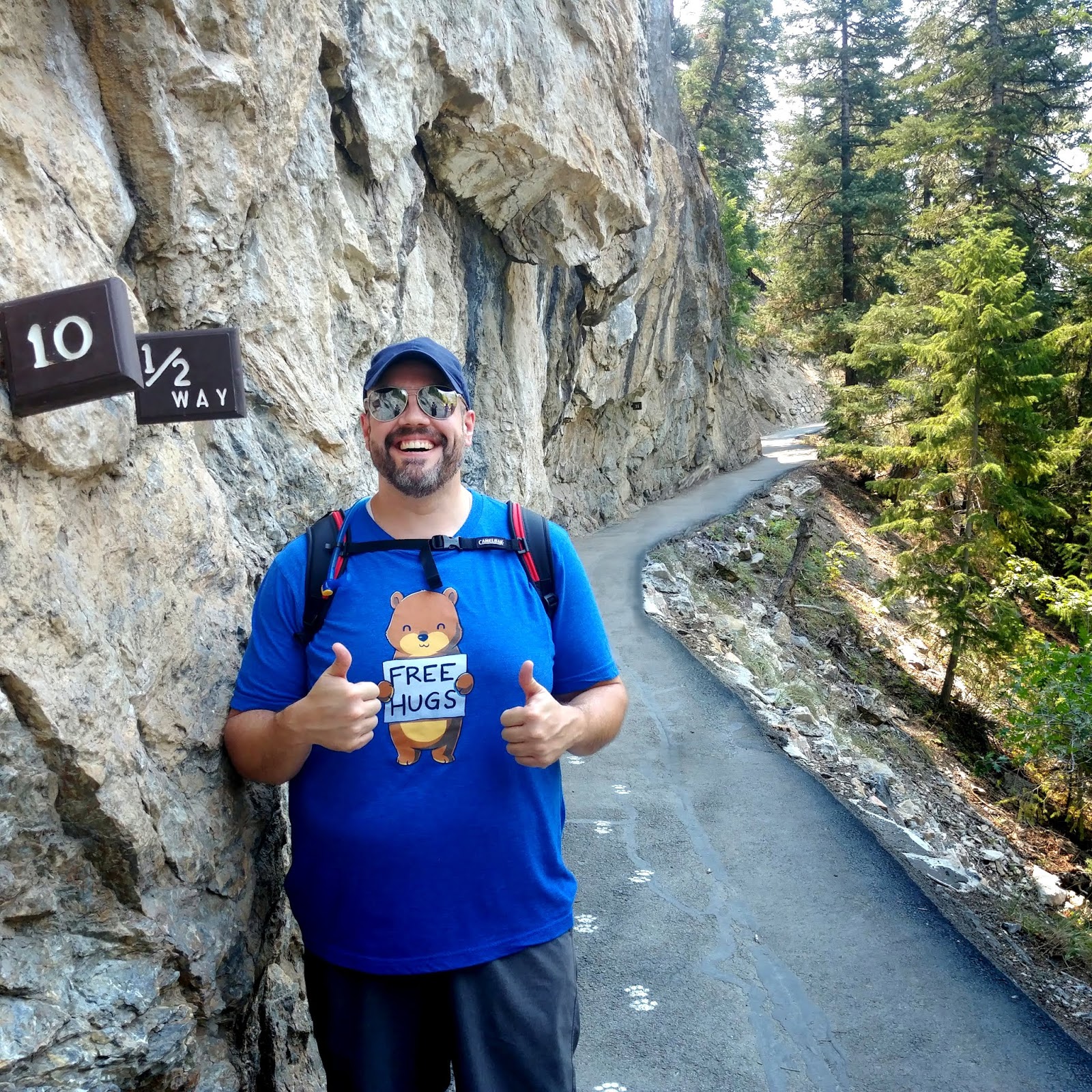


I was afraid I wouldn’t be able to make it from being too fat. But I wasn’t too fat to make it! Actually, I did even better than I thought I would. We had an hour and a half to make our cave tour time, but we did it in 40 minutes. I was shocked! The trail was as they described, steep and strenuous. But I took it at a decent pace and just kept moving. Only pausing occasionally to catch my breath or see the view. I am not a failure.
I was afraid of getting hurt. Did I get hurt? Nope! I actually felt really good through the whole thing and even when we were done, while I was tired, I wasn’t wasted or worn out. I actually think, if I’d had to, I could’ve gone right back up and done it again! I didn’t have any nagging aches and pains. I was able to move well on the trail and in the cave (there are some tight spots in there!). I am not weak.
I was afraid of getting left behind. I think I pushed myself a little bit at the start because I was afraid of being left behind, but then… it didn’t happen; I didn’t get left behind. Actually, just the opposite – I kept up with or was even ahead of the others at times. What is most important to me, however, is that even though I was pushing myself to maintain a good pace, I wasn’t comparing myself to anyone else. I was just trying to do the best I could do, which entirely removed “measuring up” from the equation, period. It’s good enough just being me.
I was afraid of holding others back. This also turned out to be a “non-issue.” I hiked at the pace I needed to hike and my pace was not a reaction to what anyone else was doing, therefore, I did not interpret anyone else actions (i.e., pacing) as a reaction to what I was doing. We shared the experience, but each experienced it in our own way, and that was a great feeling. I own my feelings and experience without being responsible for the feelings/thoughts/actions of others.
Beyond all of that, experiencing the cave itself made the little explorer boy in me very happy!
At the cave, they were nice enough to let us catch an earlier tour (Thank you Jay Allen!!) and the cave was amazing! Such unique structures and environment; I could have stayed there for hours. It was so quiet and still. You could feel the moisture in the air and see it clinging to walls and ceilings. At one point they turned out the lights and I can’t recall a blacker darkness. I had to hold the arm of a buddy, because I’m afraid of the dark. I waved my hand in front of my face, but saw nothing. The constant chill in the air; pools of water; ravines that drop down to emptiness; mineral formations that seem out of this world; delicate structures that have survived for hundreds, or maybe even thousands, of years; it was all just so unique and surreal.
And I realized something. A year ago, I would not have been able to do this. Well, maybe that’s not entirely true – I think I could have done it, physically, but it would have been a miserable experience. I would not have had the endurance to keep moving. I would have been much more out of breath. I don’t know that I would have even fit through some of the narrow passages in the cave, quite frankly. And I would have been wasted when it was over. As it was, I not only completed the whole trip, but, as I said before, I probably could have done it again. That is a big, damn deal for me!
Not only did I do this (previously terrifying) hike – I actually enjoyed it! I needed to do it to realize that I had nothing to be afraid of.
It was later, as I was driving back down the canyon, and as I was thinking about the experience, I actually hollered out loud to myself, “woohoo!! You did it, man!! You f*cking did it!!” And that was the moment I realized I didn’t have to be afraid anymore, which caused me to tear up a bit, I’ll be honest. Then I did something I’m not used to doing – I told myself that I did a good job and that I was proud of myself for my accomplishment. As far as I can recall, it was the first time a message like that – coming from myself – carried weight. And maybe the first time I truly believed it.
So today was a good day. It was good for my body; it was good for my mind; it was good for my heart; and it was good for my soul.
For years I resisted fear and it weighed upon me like a boulder. Today, I held that fear in my hands and I gave it a place in my life; I allowed it to be a part of my journey. When I did so, I freed it and it drifted away from me, like a mist evaporating with the sunrise. Truly, a new dawn for me, as well.
Tuesday, July 3, 2018
Of Stupidity and Carbs
I did something stupid recently.
Have you ever done anything stupid? Like, you knew it was going to be a bad idea, even before you did it, but you did it anyway? Well, that’s what I did. I justified my “bad idea” by calling it an experiment: “If I do this, I’ll just see what happens and I’ll learn from it and it’ll be cool.”
It wasn’t cool.
Not cool, at all.
What did I do that was so stupid? I ate carbs.
Ok, I can almost hear you rolling your eyes at me… BUT, I have to explain why carbs are a stupid idea for me.
I don’t villainize carbs. I don’t think carbs are evil. I love carbs; I want to be carbs… the problem is, I have a chemical reaction to carbs that results in an “altered mental/emotional status.” More accurately, sugar carbs result in panic attacks and starchy carbs result in depression. Put ‘em both together and I get into suicidal territory. Yes, my reaction to carbs is that drastic; I’m not exaggerating here. I’ve tested this over and over and over – and always with the same result. Sometimes the reaction happens within a few hours and sometimes it doesn’t show up for a few days, but it always shows up.
This is just one reason a low-carb diet, like a ketogenic diet, has been so helpful for me, because it all but eliminates my drastic mood swings. Life still has its ups and downs, but I regulate my moods and thoughts SO much better while eating Ketogenically.
So, for the last seven-eight months I’ve been following a ketogenic diet (carbs under 20-30 grams per day, protein based on lean body mass, and fat to round out my calorie needs). I certainly haven’t been “perfect” with it – I’ve had my moments of “carb-loading,” i.e., binge eating, but this time was different. I had bread or sugar carbs EVERY DAY for a week.
So, so stupid.
For the first 3-4 days I was in heaven – tons ’o carbs and no backlash. I thought, “hey, I’m cured; I can totally have carbs now.” But about day 4 is when the cravings started and the “willpower” began to run out. I know the difference between physical hunger and “emotional” hunger and I was becoming emotionally hungry all the time! One poor decision led to another and I just kept eating more and more carbs… Then the nightmares started; waking up in the middle of the night with my heart racing and sweaty from fear/panic; or rising in the morning with a feeling of dread – that if I got out of bed, something bad was going to happen. Then came the depression. Everything in my life seemed bad, wrong, insufficient, an unsolvable problem, hopeless, helpless, like nothing would ever be okay – like I would never be okay. I became angry and annoyed by the slightest things and somehow, I just couldn’t shake hating myself for all of this. After all, I was the stupid one who ate all the carbs. I knew it was a bad idea, but I did it anyway.

I mean, haven’t I lost 70-ish pounds eating low-carb? Yep, I sure have. So haven’t I “earned” the right to spend a week eating whatever the hell I want? Erm… that’s a tough one. I think the problem with that question is in the idea that I can somehow “earn” bad food. Is that the relationship with food that I want? To be “good” so that I can earn the right to be “bad?” And by bad I just mean throw caution to the wind and fly off the nutritional rails… No, of course not! No one “earns” the right to be bad! It’s probably a bad idea (irony intended) to “moralize” food into “good” or “bad” camps, because – for me, anyway – it's too easy for it to become a reflection of who I am as an individual; i.e., I ate “bad” food, therefore I am a “bad” person.
I keep asking myself why? Why would I do this to myself KNOWING it was a “bad” idea?! I think there must be a lot of reasons. I’ve spent so long fighting cravings that I just wanted to give in. I am so tired of fighting the desire for carbs (i.e., emotional hunger) that I just wanted to lose control and not think about consequences or repercussions. I was angry that I’ve been having such bad neck/shoulder pain that no one seems to be able to resolve and I just got angry at my body for hurting for no reason – and I wanted to punish it; as if I was saying, “hey, if you’re not going to work properly and be in pain for nothing more than just moving, then screw you – I’m going to get fat and lazy and just give up on you.”
Which is sad, now that I see it typed out in black and white. What a poor relationship I seem to have with myself. I’m so ready to hurt myself and punish myself as if that’s all I deserved; it’s almost just a knee-jerk reaction at this point. It’s not healthy; it’s not caring, or kind or compassionate. It’s abusive. How did I learn this? Where did I learn this?
Honestly, I don’t think the answers to those questions even matter right now. What matters is improving that relationship. So I’m going to do some really uncomfortable work here and commit to a couple of things:
1. Forgiveness – Yep, I made a poor decision to eat a bunch of carbs (premeditated or otherwise). Beating myself up for it isn’t going to change that, it isn’t going to “pay” for my dalliance(s), and it isn’t going to prevent me from making poor choices in the future. What it will do is reinforce the erroneous belief that I’m an inherently bad/weak person, deserving of self-abuse and punishment. Forgiveness is not ignoring what I did, or trying to remove/avoid consequences; forgiveness is me admitting I made a bad choice, but knowing that I am not a “bad person” because of it. Forgiveness is saying, “I care enough about you that I don’t want you to repeat that behavior, because I don’t want you to hurt anymore…”
2. Embrace pain. This may sound like it’s coming from left field or you may be wondering how “embracing pain” could help me change these destructive patterns. Well, it’s because pretty much all of my dysfunctional patterns are some form of avoiding pain (physical, mental, emotional, etc.). Pain is an indicator that something is wrong. Because of my trauma’s and learned self-abuse, I interpret “something wrong” to mean that I’ve done something wrong or that I am wrong; that I have somehow caused this pain. So when I feel pain, I blame myself for having done something wrong to cause it. Embracing pain means exposing myself to life and being vulnerable; it means challenging my beliefs about myself and more specifically what I’m worth or what I think I’m capable of. Pain is nature’s way of saying something needs my attention, not an indication that I’ve done something wrong or that I “am” wrong. Pain, while unpleasant to experience, can actually be an ally, and one I probably need to stop “avoiding at all costs.” I can be in pain and still be okay.
Deep down I know my days of making stupid decisions aren’t over. I’m certain I have plenty more to make. But my hope is that I can, at the very least, learn from when I’ve chosen poorly in the past and use that feedback to make wiser decisions in the future – especially when it comes to carbs!
Subscribe to:
Posts (Atom)